How to Choose an Underpad Machine in 2026?
Choosing an underpad machine in 2026 requires more than comparing prices and advertised production speeds. The right decision begins with your real product requirements. Consider underpad dimensions, absorbent core materials, SAP distribution, backsheet films, and folding patterns. A machine designed for hospital underpads may not suit pet pads or elder-care products. Small differences matter. They affect waste, comfort, packaging, and customer complaints.
According to underpad machinery specialist Michael Chen, “A machine proves its value through stable output, not impressive specifications.” That principle deserves attention when reviewing suppliers. Ask for verified running speeds, reject rates, changeover times, and energy consumption. Request videos of similar materials running on the proposed line. Better still, arrange a factory test using your own raw materials. A polished demonstration can hide practical weaknesses.
Reliable selection also depends on engineering support after installation. Check spare-parts availability, remote diagnostics, operator training, and local service coverage. Examine the tension-control system closely. Uneven tension can create wrinkles, shifting cores, and inconsistent sealing. Inspect the stacking unit, too. Poor stacking may slow packaging even when the main line runs quickly.
No machine is perfect. Your assumptions may be wrong. A cheaper line could become expensive through downtime and material waste. An advanced model could exceed your actual needs. Build a comparison sheet using measurable evidence, not attractive brochures. The best underpad machine is the one that delivers consistent quality, manageable maintenance, and dependable output for your specific operation.
What an Underpad Machine Is and How It Works
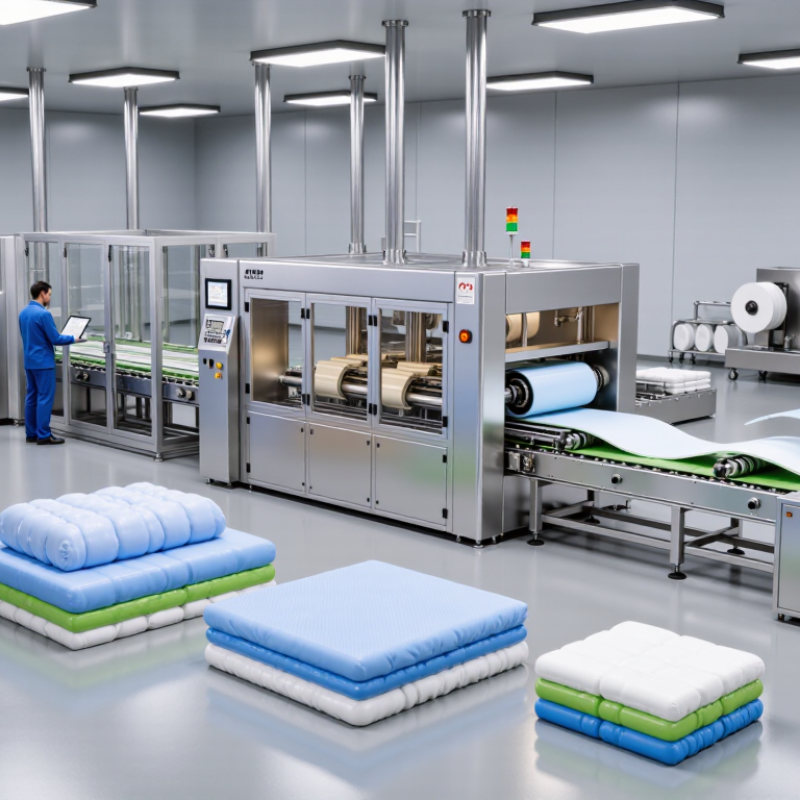
An underpad machine converts raw materials into absorbent protective pads for beds, chairs, and examination surfaces. It usually unwinds nonwoven fabric, tissue, absorbent pulp, superabsorbent polymer, and a waterproof backsheet. Rollers align each layer before compression, sealing, cutting, folding, and stacking. Servo-driven controls keep pad length and registration stable.
The need is growing. The United Nations World Social Report 2023 states that people aged 65 or older may reach 16% of the global population by 2050. The United Nations World Population Prospects 2024 gives a similar warning about population ageing. This shift increases demand for dependable absorbent products in care facilities and homes.
When choosing equipment in 2026, inspect actual output rather than advertised speed. A 120-meter-per-minute line may slow sharply with thicker cores or frequent size changes. Ask for trial data covering absorbency, leakage, dust, waste, and changeover time. ISO 11948-1 provides a recognized method for testing liquid absorption in incontinence products. The machine should support controlled SAP dosing and even pulp distribution. It also needs sensors for missing material, poor sealing, and cutting errors.
A faster line is not automatically better. In factory trials, small alignment errors can create large material losses. I would compare ten consecutive production hours, not one impressive test run. Power use, operator access, cleaning time, and spare-part availability deserve equal attention. Some purchasing decisions still overlook them.
How to Define Production Needs and Product Specifications
Choosing an underpad machine starts with the patient, not the machine catalogue. Define the users, care setting, daily demand, and expected product life. The World Health Organization reports that one in six people worldwide will be aged 60 or older by 2030. This signals sustained demand, but it does not justify building the largest line. Local consumption data matters more.
Write the product specification in measurable terms. Record pad length, width, core weight, absorbency target, leakage resistance, and sealing method. A hospital pad may need a larger acquisition layer, while a home-care pad may prioritize softness and low noise. Set acceptable limits for fluff pulp, superabsorbent polymer, nonwoven basis weight, and packaging count. Use recognized testing methods, such as strike-through, rewet, and liquid retention tests. Small changes in core distribution can affect performance.
Production planning should connect these figures to equipment capacity. Calculate usable minutes, changeover time, reject rates, and seasonal demand. A line rated at 300 pads per minute may produce much less after maintenance and material changes. That assumption can fail. Request trial samples using your actual materials, not only supplier samples. Check dust control, operator access, servo stability, and spare-part availability. The United Nations World Population Prospects 2022 projects the global population aged 60 and above to reach 2.1 billion by 2050, yet future demand remains uneven. I would leave room for adjustment. Rigid specifications can become expensive mistakes.
How to Choose an Underpad Machine in 2026?
Compare the material area required for common underpad formats before defining machine width, cutting layout, and production capacity.
The chart uses standard underpad formats and calculates the surface area of each finished product. Larger formats consume more nonwoven fabric, absorbent material, and waterproof film per unit. When selecting a machine, match its effective working width and cutting layout to your required formats, then calculate output from daily unit demand, operating hours, changeover time, and expected material waste.
Which Machine Features and Technologies Matter Most
How to Choose an Underpad Machine in 2026?
Which Machine Features and Technologies Matter Most
The strongest buying decision starts with product requirements, not a glossy speed claim. Measure target sizes, absorbent core weight, SAP distribution, and hourly output. The machine should handle fluff pulp and SAP evenly, while keeping the nonwoven surface smooth. Servo-driven dosing improves repeatability. Independent tension control reduces wrinkles during high-speed forming. Ask for production samples, not only a demonstration. Small variations can create wet spots, rejected packs, and customer complaints.
Modern control systems deserve close attention. A reliable PLC should store recipes for different sizes and absorbency levels. Quick recipe changes reduce setup errors and material waste. Vision sensors can identify missing cores, edge shifts, and poor sealing. Automatic rejection is useful, but operators must verify its accuracy. Dust extraction also matters, especially around pulp forming and cutting areas. Cleaner air supports safer maintenance and steadier production.
Check the sealing system carefully. Ultrasonic or heat sealing should create consistent edges without damaging the backsheet. Test the machine during startup, speed changes, and material replacement. These moments reveal weaknesses. Energy monitoring can expose inefficient heaters, motors, or compressed-air leaks. I would not assume maximum speed means better value. A slower line with stable quality may produce more saleable packs. My own evaluation would include noise, access for cleaning, spare-part availability, and operator training. No machine is perfect. Build time for adjustment, because real materials rarely behave exactly like test samples.
How to Compare Capacity, Materials, Automation, and Operating Costs
Choosing an underpad machine in 2026 requires more than comparing advertised speed. Capacity should match real demand, not the brochure’s maximum output. Measure good units per minute after material changes, maintenance, and rejects. Smithers’ The Future of Global Nonwovens to 2028 identifies continued growth in hygiene nonwovens, but growth does not justify buying excessive capacity. An oversized line may increase idle time, energy use, and operator costs.
Material compatibility matters. Test fluff pulp, superabsorbent polymer, tissue, nonwoven fabric, and polyethylene film on the same line. Check absorbency, sealing strength, dust control, and material waste. EDANA’s sustainability guidance emphasizes resource efficiency across nonwoven production. A machine that runs quickly but wastes 4% more material may be more expensive over a year. That detail is easy to miss. My practical concern is simple: suppliers often quote ideal conditions, while factories face humidity, inconsistent pulp, and frequent size changes.
Tips: Request a witnessed production trial using your materials. Record actual output, scrap rate, changeover time, compressed-air use, and electricity consumption. Compare labor hours per 10,000 finished pads. Automation can reduce repetitive handling, but sensors, servo drives, and software require skilled maintenance. Calculate payback using local energy and labor prices, not generic estimates. The U.S. Energy Information Administration’s manufacturing energy data shows that electricity costs vary significantly by region, so copied operating models can mislead. Leave room for human judgment. Full automation is not always the wisest choice.
How to Choose an Underpad Machine in 2026? - How to Compare Capacity, Materials, Automation, and Operating Costs
| Comparison Dimension | Compact / Entry-Level | Standard Automatic | Industrial High-Speed | What to Check Before Buying |
|---|---|---|---|---|
| Typical rated speed | 60–120 pads/min | 120–220 pads/min | 220–400 pads/min | Confirm whether the quoted speed is rated speed or tested speed with a specific product size and material structure. |
| Practical output at 75% efficiency | 2,700–5,400 pads/hour | 5,400–9,900 pads/hour | 9,900–18,000 pads/hour | Use actual output after material loading, roll changes, cleaning, adjustment, and rejects—not only the maximum line speed. |
| Suitable production volume | Up to approximately 1.0 million pads/month | Approximately 1.0–2.5 million pads/month | More than approximately 2.5 million pads/month | Calculate monthly demand using available production hours, planned maintenance, changeovers, and the target reject rate. |
| Common finished pad sizes | 400 × 600 mm to 600 × 900 mm | 450 × 600 mm to 750 × 900 mm | 500 × 600 mm to 900 × 1200 mm | Verify the minimum and maximum product length, width, thickness, folding pattern, and packaging format. |
| Absorbent core materials | Fluff pulp with optional SAP dosing | Fluff pulp, SAP, tissue or airlaid core | Multi-layer core with controlled pulp and SAP distribution | Check compatibility with the required SAP percentage, pulp type, core thickness, dosing accuracy, and dust-control system. |
| Top-sheet materials | Hydrophilic nonwoven, commonly 10–25 gsm | Hydrophilic spunbond or composite nonwoven, commonly 10–30 gsm | High-speed compatible nonwoven with controlled unwind tension | Confirm roll width, core diameter, maximum roll diameter, basis-weight range, and web-tension control. |
| Backsheet materials | PE film or breathable PE film, commonly 15–40 gsm | PE film, breathable film, or laminated film | High-strength film or laminated structures with automatic tension control | Check sealing temperature range, film elongation, coefficient of friction, puncture resistance, and print or embossing requirements. |
| Material-loading configuration | 3–5 main unwind stations | 5–8 unwind and dosing stations | 8 or more stations, often with automatic splicing | Count every required layer: top sheet, backsheet, tissue, pulp, SAP, acquisition layer, elastic, adhesive, and packaging film. |
| Core-forming method | Basic pulp forming or pre-formed core feeding | Controlled pulp forming with metered SAP dosing | Continuous forming with multiple dosing and inspection controls | Evaluate core-weight variation, SAP distribution, dust collection, forming-mold maintenance, and cleaning time. |
| Automation level | PLC control, manual roll changes, basic alarms | PLC/HMI control, servo drives, automatic tension adjustment, recipe storage | Centralized control, automatic splicing, vision inspection, remote diagnostics, and production data logging | Ask for the automation functions included as standard and identify which functions require optional modules. |
| Recommended operators per shift | 2–3 operators | 1–2 operators | 1–2 operators plus maintenance support | The actual requirement depends on packaging, material handling, quality inspection, and local safety procedures. |
| Installed electrical load | Approximately 20–45 kW | Approximately 40–80 kW | Approximately 70–140 kW | Confirm actual running demand, compressed-air consumption, voltage, frequency, dust extraction, and available factory capacity. |
| Compressed-air requirement | Approximately 0.3–0.8 m³/min at 0.6–0.8 MPa | Approximately 0.6–1.5 m³/min at 0.6–0.8 MPa | Approximately 1.0–2.5 m³/min at 0.6–0.8 MPa | Size the compressor using the machine’s peak demand, air quality requirements, leakage allowance, and future expansion plans. |
| Typical machine footprint | Approximately 8 × 3 m to 12 × 4 m | Approximately 12 × 4 m to 18 × 5 m | Approximately 18 × 5 m to 30 × 7 m | Include space for raw-material storage, operator access, maintenance clearance, finished-product packing, and dust collection. |
| Changeover time | 30–90 minutes | 20–60 minutes | 10–40 minutes with prepared recipes and automatic settings | Request a demonstration using two different pad sizes and calculate the lost output during a normal production day. |
| Expected reject rate after stabilization | Approximately 2–5% | Approximately 1–3% | Approximately 0.5–2% | Define defects clearly, including missing SAP, poor sealing, wrinkles, incorrect cutting, contamination, and package-count errors. |
| Indicative electricity use | 0.10–0.25 kWh per 1,000 pads | 0.08–0.18 kWh per 1,000 pads | 0.06–0.15 kWh per 1,000 pads | Lower energy per pad does not always mean lower total cost if the line is oversized for the required demand. |
| Indicative direct labor cost | Approximately USD 2.50–6.00 per 1,000 pads | Approximately USD 1.50–4.00 per 1,000 pads | Approximately USD 1.00–3.00 per 1,000 pads | Recalculate using local wages, shift length, benefits, overtime, packaging labor, and the number of operators actually required. |
| Maintenance and consumables | Approximately USD 1.00–3.00 per 1,000 pads | Approximately USD 0.80–2.50 per 1,000 pads | Approximately USD 0.70–2.00 per 1,000 pads | Include blades, belts, bearings, filters, sealing components, lubricants, sensors, and planned service labor. |
| Conversion cost excluding raw materials | Approximately USD 4.00–10.00 per 1,000 pads | Approximately USD 2.50–7.00 per 1,000 pads | Approximately USD 2.00–5.50 per 1,000 pads | This estimate excludes pulp, SAP, nonwoven, film, adhesive, packaging, rent, financing, depreciation, and taxes. |
| Best choice when | Demand is uncertain, product variety is high, or initial investment must be limited. | Demand is stable and the factory needs a balance between flexibility, output, and labor efficiency. | Large-volume orders justify high utilization, advanced automation, and lower unit conversion costs. | Choose the smallest machine that can meet forecast demand with capacity for growth and acceptable changeover losses. |
How to Verify Quality, Safety, Maintenance, and Supplier Support
How to Choose an Underpad Machine in 2026?
A reliable underpad machine should produce even absorbent cores, clean seals, and consistent dimensions. Ask for production samples from several operating speeds. Inspect the edges closely. They should remain smooth, without exposed material or loose adhesive. Request records for material testing, electrical safety, guarding, and noise levels. These documents should match the machine’s actual configuration, not an older model. Verify compliance with applicable local requirements before signing a purchase contract.
Safety checks must include emergency stops, interlocked covers, sensor protection, and a clear lockout procedure. Watch the waste path. Poorly managed trimming waste can cause jams and unsafe manual clearing. Operators should receive practical training, including safe adjustment during a running shift. Do not guess. A short factory demonstration may hide faults that appear after several hours.
Maintenance access matters as much as output. Check whether belts, cutters, heaters, and sensors can be reached without removing half the machine. Request a preventive maintenance schedule with recommended spare parts and inspection intervals.
I once saw a high-output line lose time because one inexpensive sensor was unavailable. That experience changed how I evaluate suppliers.
Ask about response times, remote diagnosis, technician availability, installation support, and training records. Written service terms are safer than friendly promises. A checklist helps, but it can still miss uncomfortable details, so speak with actual operators before approval.
Related Posts
-
How to Choose the Best Underpad Machine in 2026?
-

7 Tips for Global Buyers Choosing the Best Underpad Machine?
-
How to Use an Underpad Machine for Efficient Laundry Management?
-
Top Underpad Manufacturing Machine Techniques for Optimal Production Quality?
-
Why Invest in an Underpad Manufacturing Machine for Your Business?
-
How to Choose the Best Underpad Manufacturing Machine?