7 Best Diaper Machines for Global Buyers?
Choosing the right diaper machine can shape product quality, production costs, and long-term business stability. Global buyers need more than attractive specifications. They need equipment that matches local demand, factory space, workforce skills, and service access.
This guide examines seven leading options through practical buying criteria. These include production speed, diaper size flexibility, material compatibility, automation, energy use, and quality inspection. It also considers machine footprint, changeover time, spare-part availability, and technical training. A reliable supplier should provide clear performance data, factory references, installation support, and responsive maintenance. Details matter.
Real factory conditions often differ from catalog promises. A machine rated for high output may slow during frequent size changes. A compact model may save space but limit future expansion. Fit varies. Buyers should request product samples, trial reports, and transparent acceptance standards before making a final decision. Independent checks are valuable when claims seem unusually strong.
The seven machines discussed here are not ranked for every buyer. A high-volume manufacturer may prioritize speed and automated packaging. A growing regional producer may value flexibility, simpler maintenance, and lower investment risk. Buyers should also confirm applicable safety, environmental, labeling, and product-quality requirements in each target market. These requirements can influence materials, documentation, and machine configuration.
No comparison is perfect. Supplier updates, component availability, and after-sales performance can change over time. Still, a careful evaluation can reduce costly surprises. Use this overview as a practical starting point, then verify specifications with qualified manufacturers and experienced engineers.
What a Diaper Machine Is and How It Works
7 Best Diaper Machines for Global Buyers?
What a Diaper Machine Is and How It Works
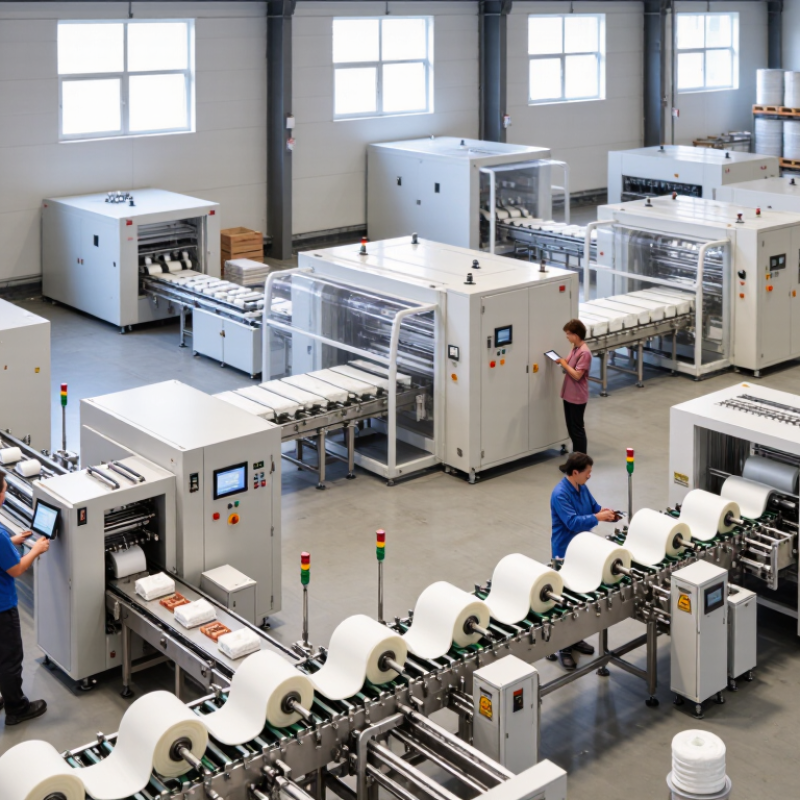
A diaper machine is an automated production line that converts material rolls into finished disposable diapers. It usually handles nonwoven fabric, absorbent pulp, tissue, elastic strands, fastening tabs, and packaging film. The process begins with controlled unwinding. Servo motors keep each material aligned as it moves through the line. A forming unit shapes the absorbent core and places superabsorbent polymer inside it. Then, layers are bonded with heat or carefully metered adhesive. This core needs even distribution.
Next, the machine adds leg elastics, waist bands, side panels, and closure systems. Rotary cutters create the diaper outline, while folding stations prepare its final shape. Sensors check web tension, registration, missing materials, and visible defects during production. A programmable control system adjusts speed and timing, but operators still matter. They inspect samples, replace worn parts, and respond when alarms appear. Small alignment errors can become large waste. No machine is perfect.
For global buyers, machine selection should match diaper size ranges, output targets, material availability, and local maintenance skills. Ask for verified production data, trial results, utility requirements, and safety documentation. A fast line is not always the best line. Stable quality often matters more than peak speed. In practical trials, specifications may look impressive, yet performance can change with setup and raw materials. Testing with intended materials is wiser. Even experienced teams need room for learning.
Main Types of Diaper Machines for Different Production Needs
Diaper machines differ by product, speed, and factory scale. Baby diaper machines usually support elastic waistbands, leak guards, and adjustable absorbent cores. Pull-up machines use stronger side panels and precise ultrasonic cutting. Adult incontinence machines need larger cores and wider material paths. According to Grand View Research, the global baby diapers market was valued at about USD 83.3 billion in 2023. Fortune Business Insights estimated the adult diapers market at roughly USD 17.5 billion in the same year. These figures show why product-specific machinery matters.
High-speed fully servo machines suit large orders and stable demand. They can reduce alignment errors, but they require skilled maintenance and consistent raw materials. Semi-automatic machines need less capital and fit regional factories, contract production, or market testing. Modular machines offer another practical option. Operators can upgrade folding, packing, or core-forming units later. Smithers’ nonwovens industry reports continue to highlight hygiene products as an important demand area. Still, buying only for maximum speed can be a mistake. Some assumptions fail in practice.
Tips: Check hourly output, changeover time, power use, and waste rates. Request test production with your actual fluff pulp, nonwoven fabric, and elastic. Inspect the machine during a full shift, not a short demonstration. Keep spare cutting tools nearby. Also, calculate labor and maintenance costs before comparing prices.
Seven Diaper Machine Options for Global Buyers
Global buyers need more than the fastest diaper machine. They need the right fit for demand, labor, utilities, and product design. Fortune Business Insights valued the global baby diapers market at about USD 83.67 billion in 2023. Its report also expects continued growth through 2030. That growth does not guarantee easy production.
Seven diaper machine options serve different factory goals: a compact entry-level line for regional demand; a standard high-speed line for stable volume; a premium baby diaper line for advanced absorbency; a diaper pants line for active children; an adult incontinence line for healthcare markets; a hybrid line for mixed product sizes; and a modular line for gradual expansion. Grand View Research reports strong growth in adult incontinence products, driven by aging populations and wider hygiene awareness. That trend may justify a second product category, but only after local demand is verified.
Details matter. Check hourly output, changeover time, core-forming accuracy, dust control, compressed-air use, and waste rates. A machine claiming 800 pieces per minute may perform differently with thicker cores or larger sizes. Request production samples using your own materials. Ask for three months of spare-parts records, operator training plans, and remote service response times. ISO 15621 guidance can support absorbent hygiene product evaluation, while local electrical and workplace requirements still apply. Used machinery can reduce investment, yet hidden wear may increase downtime. A spreadsheet cannot reveal every problem. One factory trial can.
7 Best Diaper Machines for Global Buyers
Indicative rated production capacity by machine configuration
The chart compares seven commonly used diaper-machine configurations by indicative rated output. Actual production depends on diaper size, product design, material specifications, changeover time, operator skill, and factory conditions. Higher-speed systems generally require greater investment, more advanced automation, and stricter quality control.
How to Compare Speed, Automation, and Product Compatibility
7 Best Diaper Machines for Global Buyers?
How to Compare Speed, Automation, and Product Compatibility
Global buyers should compare diaper machines by output, stability, and product range, not speed alone. Grand View Research estimated the global baby diapers market at about USD 83.9 billion in 2023, with continued growth through 2030. That demand favors high-speed equipment, but maximum speed can create higher material waste and more difficult maintenance.
The seven strongest machine categories include baby diaper lines, adult incontinence lines, pull-up pants, training pants, newborn systems, night-use systems, and flexible multi-size lines. A high-speed baby diaper machine may produce 600 to 1,000 pieces per minute. However, adult products usually require stronger absorbent cores, wider materials, and different folding systems. Product compatibility matters more than impressive brochure numbers.
Automation should cover tension control, visual inspection, glue monitoring, automatic splicing, and size changes. An experienced technician will also check changeover time. Ten minutes saved per shift can matter more than another 100 pieces per minute. Smithers’ hygiene market analysis highlights the importance of product innovation and manufacturing efficiency across absorbent hygiene products. Still, reports rarely show the full cost of rejected goods, spare parts, or operator training.
Request production samples using your own nonwoven fabric, fluff pulp, elastic, and packaging format. Ask for stable speed, not laboratory speed. A machine can run fast once. It must run reliably every day. I would also leave room for doubt: the cheapest compatible line may become the most expensive after repeated stoppages.
Key Factors to Check Before Purchasing a Diaper Machine
7 Best Diaper Machines for Global Buyers?
Choosing among the seven best diaper machines requires more than comparing production speed. Check the machine’s output under real operating conditions, not only its brochure rating. A line rated at 600 pieces per minute may slow down with larger sizes or thicker absorbent cores.
Inspect the size range, material compatibility, and changeover process. Operators should adjust waistbands, elastic placement, and core alignment without excessive manual work. Ask for a factory test using your intended materials. Watch the finished diapers closely. Uneven gathers, loose tabs, or shifting cores reveal problems quickly. Also measure power consumption, compressed-air demand, floor space, and noise levels before signing a purchase agreement.
Reliable support matters across borders. Confirm spare-part availability, remote troubleshooting, installation training, and response times in writing. Review electrical standards, safety guards, documentation, and maintenance access for your destination market. A machine with sealed cabinets and clear diagnostic screens can reduce downtime. It may also simplify operator training.
Do not ignore cleaning routines. Adhesive buildup around rollers can affect production within hours. Some purchasing teams focus too heavily on speed and underestimate waste during material changes. That is a costly mistake. A lower-speed machine with stable tension control may deliver more saleable products each day. Request sample output, maintenance records, and references from comparable operations. Then question the data. Not every impressive trial reflects long-term performance.
7 Best Diaper Machines for Global Buyers? - Key Factors to Check Before Purchasing a Diaper Machine
| No. | Machine Type | Typical Output (pieces/min) |
Common Product Range | Typical Size Range | Main Materials Processed | Important Automation Features | Approx. Installed Power | Typical Footprint | Best Suited For | Key Checks Before Purchase |
|---|---|---|---|---|---|---|---|---|---|---|
| 1 | Standard Baby Diaper Production Line | 300–600 | Tape-style disposable baby diapers | Newborn to XL, usually 4–25 kg | Fluff pulp, SAP, nonwoven fabric, PE film, elastic, acquisition tissue | PLC control, servo drives, automatic tension control, reject detection, automatic counting and stacking | 180–350 kW | 35–55 m long × 8–12 m wide | Large-scale production of mainstream baby diaper sizes | Confirm actual speed at saleable quality, size-change time, SAP dosing accuracy, spare-parts availability and operator training. |
| 2 | High-Speed Baby Diaper Line | 600–1,000+ | Premium, high-absorbency baby diapers with advanced features | Newborn to XXL, depending on configuration | Fluff pulp, SAP, breathable backsheet, hydrophilic topsheet, elastic components, acquisition layer | Closed-loop servo control, vision inspection, automatic splicing, web guiding, online defect rejection | 300–600 kW | 45–70 m long × 9–14 m wide | High-volume facilities with stable demand and strong quality control | Evaluate sustained output, energy consumption per diaper, noise level, dust extraction, installation requirements and technical support response time. |
| 3 | Adult Brief Diaper Machine | 150–400 | Refastenable adult incontinence briefs with side tapes | Small to XXL, commonly 45–150 cm waist | Fluff pulp, SAP, nonwoven topsheet, breathable film, elastics, hook-and-loop or adhesive tapes | Servo-controlled folding, elastic placement, tape application, leak-guard forming and automatic size adjustment | 150–300 kW | 30–50 m long × 8–12 m wide | Healthcare, elderly-care and export markets requiring multiple absorbency levels | Check absorbency consistency, core compression performance, waist-fit accuracy, tape strength, size flexibility and compliance with applicable medical-product regulations. |
| 4 | Baby Pull-Up Diaper Machine | 300–700 | Pant-style training pants and pull-on baby diapers | M to XXL, usually 6–35 kg | Nonwoven materials, elastics, SAP, fluff pulp, breathable film, fastening or tear-away components | Continuous elastic insertion, ultrasonic or adhesive bonding, automatic waist forming, folding and packaging interface | 200–450 kW | 35–60 m long × 8–13 m wide | Markets where pull-on convenience and freedom of movement are important | Verify elastic recovery, side-seam strength, leg-opening symmetry, material waste, changeover performance and compatibility with the planned packaging system. |
| 5 | Adult Pull-Up Pants Machine | 150–350 | Pull-on adult incontinence pants | Medium to XXL, commonly 70–160 cm waist | Elastic nonwoven, SAP, fluff pulp, breathable backsheet, topsheet and leg-gather materials | Elastic control, ultrasonic sealing, online inspection, automatic stacking and variable-frequency or servo motion control | 180–350 kW | 30–55 m long × 8–12 m wide | Retail, home-care and institutional incontinence-product production | Test waist elasticity, tear-away performance, leakage protection, absorbency capacity, material availability and the machine’s ability to handle different product grammages. |
| 6 | Compact or Modular Diaper Machine | 100–300 | Limited-size baby diapers or selected adult diaper products | A selected range, often 2–4 sizes | Fluff pulp, SAP, nonwoven fabric, film, elastics and adhesive materials | Modular stations, semi-automatic material loading, PLC interface, simple recipe management and manual or automatic packing connection | 80–180 kW | 18–35 m long × 6–10 m wide | Start-ups, regional producers, contract manufacturing and markets with moderate demand | Compare output per operator, expansion options, manual intervention points, changeover complexity, total cost of ownership and local service capability. |
| 7 | Multi-Size Flexible Diaper Production Line | 250–600 | Multiple baby diaper, adult brief or pull-up configurations | Usually 4–8 sizes, subject to tooling and product design | Variable-width nonwovens, SAP, fluff pulp, films, elastics, tapes and optional odor-control or acquisition layers | Recipe-based control, quick-change tooling, automatic web alignment, servo synchronization, inspection system and production data logging | 180–400 kW | 30–60 m long × 8–13 m wide | Global buyers serving several countries, private-label orders and frequently changing product portfolios | Assess changeover time, tooling cost, product-development support, electrical compatibility, documentation language, remote diagnostics and availability of consumable spare parts. |
Related Posts
-
China Top Diaper Manufacturing Equipment Suppliers
-
China Best Diaper Manufacturing Equipment Suppliers
-
Top 10 Diaper Manufacturing Equipment You Need for a Successful Factory
-
How to Choose the Right Machinery Machine for Your Business?
-
China Top 10 Industrial Machinery Manufacturers
-
China Top 10 Machinery Machine Suppliers?